
Answer Summary
Preparing early for end-of-year financial audits helps DME providers reduce findings, avoid last-minute disruption, and protect cash flow. In 2026, proactive review of documentation, A/R integrity, and workflow consistency is essential for audit readiness.
Introduction: Why Waiting Until Q4 Creates Risk
End-of-year audits rarely fail because of a single mistake made in December. They fail because of small issues that accumulated quietly throughout the year.
By the time auditors arrive:
- Staff may no longer remember context
- Documentation may be harder to retrieve
- Corrections become reactive instead of preventative
Preparing early gives providers time to correct gaps while records, systems, and staff knowledge are still accessible.
What Financial Audits Typically Examine
While audit scope varies, most financial audits focus on traceability and consistency, including:
- Revenue recognition accuracy
- Alignment between billed services and supporting documentation
- A/R balances and aging integrity
- Internal controls over billing and collections
- Policy and procedure adherence
Auditors are looking for patterns — not perfection.
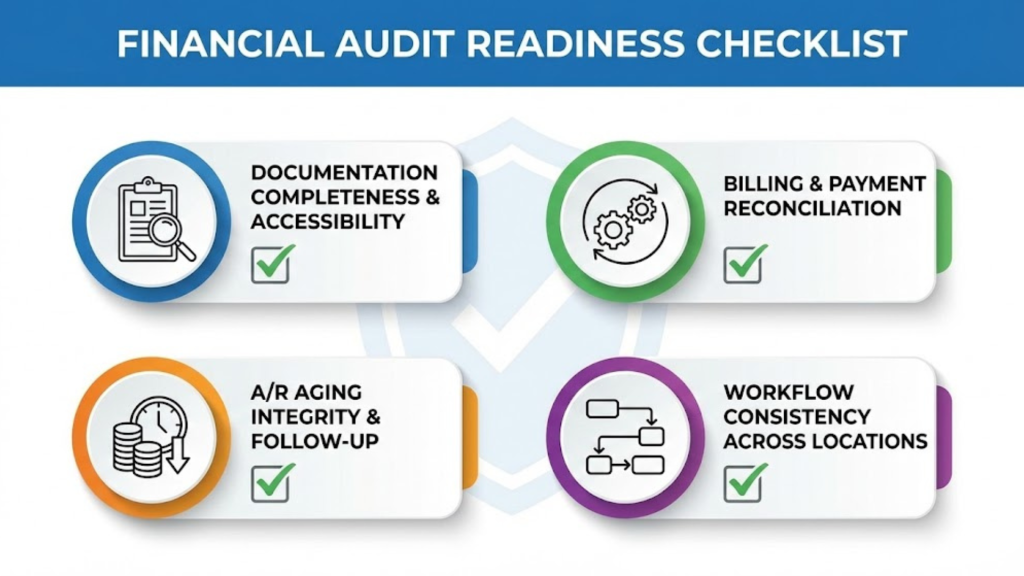
Key Area #1: Documentation Completeness and Accessibility
Audits often uncover:
- Missing physician orders
- Incomplete proof of delivery
- Inconsistent supporting documentation
Best practices include:
- Confirming required documents exist for sampled claims
- Ensuring documents are easy to retrieve
- Verifying documentation aligns with billed items
Documentation issues are easier to correct before audits begin.
Key Area #2: Billing and Payment Reconciliation
Reconciliation gaps raise immediate red flags.
Providers should:
- Confirm billed amounts match payments received
- Investigate unexplained adjustments or write-offs
- Ensure payment postings are timely and accurate
Clear reconciliation builds auditor confidence and reduces follow-up questions.
Key Area #3: A/R Aging Integrity
Auditors frequently examine:
- Accuracy of aging reports
- Reasonableness of outstanding balances
- Consistency in follow-up activity
If A/R aging does not reflect reality, it suggests weak internal controls.
Key Area #4: Workflow Consistency
Inconsistent workflows create inconsistent results.
Audit risk increases when:
- Processes vary by location or staff member
- Documentation standards are applied unevenly
- Policies exist but are not followed operationally
Consistency matters more than complexity.
Common Audit Pitfalls to Address Early
- Relying on “we’ve always done it this way”
- Assuming paid claims are compliant claims
- Delaying cleanup until auditors request information
- Lacking clear ownership for audit preparation
Early review helps avoid these traps.
How Wonder Worth Solutions Helps
Wonder Worth Solutions helps DME providers align financial workflows, documentation practices, and internal controls so audits are less disruptive and more predictable.
Conclusion
Audit readiness is not a year-end scramble — it’s the result of steady discipline. Providers that prepare early enter audits confidently and protect both revenue and reputation.