Answer Summary
Ongoing compliance monitoring helps DME providers detect risk early, correct process drift, and reduce audit exposure. In 2026, effective monitoring relies on clear cadence, measurable thresholds, and operational ownership.
Introduction: Why Compliance Fails Quietly
Compliance breakdowns rarely occur suddenly. They develop slowly as:
- Staff change
- Payer rules evolve
- Volume increases
- Workarounds become habits
Without monitoring, these changes go unnoticed until an audit or recoupment occurs.
What Compliance Monitoring Is (and Is Not)
Compliance monitoring is:
- Continuous
- Data-driven
- Process-focused
It is not:
- Annual policy review only
- Reactive cleanup
- One-time audits
Monitoring turns compliance into an operational discipline.
Step 1: Define What You Monitor
Effective monitoring typically includes:
- Documentation completeness
- Denial trends by payer and product
- Modifier and coding consistency
- Authorization turnaround times
- A/R follow-up adherence
Trying to monitor everything leads to monitoring nothing.
Step 2: Establish a Cadence
A practical cadence looks like:
- Monthly: denial trends, documentation sampling
- Quarterly: workflow consistency checks
- Ongoing: policy and payer update tracking
Regular review prevents drift from becoming systemic.
Step 3: Set Actionable Thresholds
Monitoring without thresholds creates noise.
Examples:
- A denial rate increase of more than 3% triggers a review.
- Repeated documentation gaps trigger retraining
- Payer payment lag exceeding baseline triggers escalation
Thresholds ensure monitoring leads to action.
Step 4: Assign Clear Ownership
Compliance fails when “everyone” owns it.
Effective programs define:
- Who reviews data
- Who investigates issues
- Who approves corrective actions
Ownership creates accountability without blame.
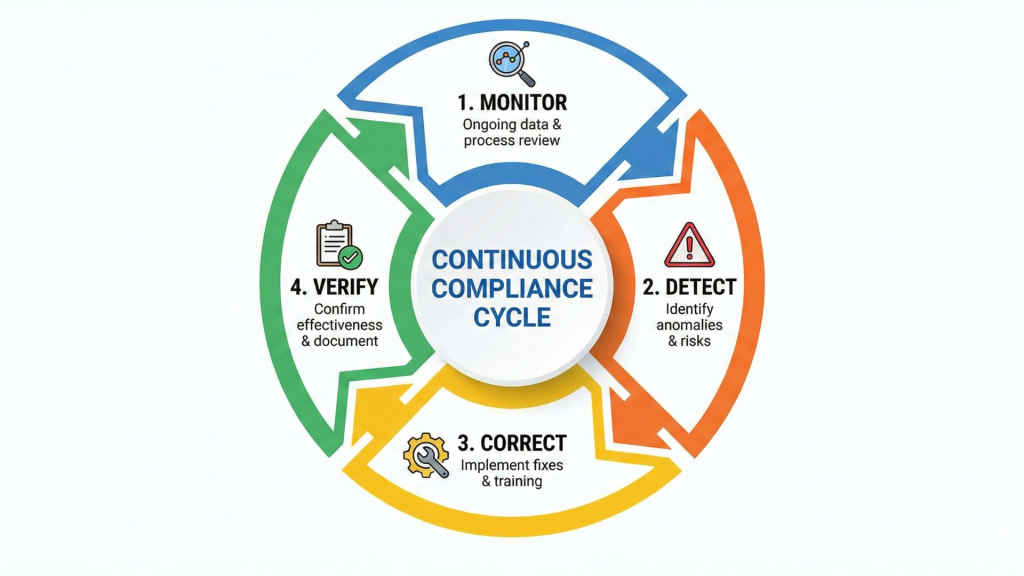
Step 5: Document and Verify Corrections
Auditors expect evidence of:
- Issue identification
- Corrective action
- Verification that fixes worked
Documentation closes the loop.
Common Monitoring Mistakes
- Reviewing data but not acting
- Over-monitoring low-risk areas
- Failing to communicate findings
- Treating compliance as a billing-only function
Monitoring must support operations — not overwhelm them.
How Wonder Worth Solutions Helps
Wonder Worth Solutions helps providers design compliance monitoring frameworks that fit daily operations and support audit readiness.
Conclusion
In 2026, staying compliant means staying visible. Monitoring allows providers to correct course early — before auditors do it for them.