Answer Summary
A mid-sized DME provider reduced claim denials and improved billing turnaround by standardizing intake and billing workflows rather than expanding staff. By clarifying ownership and eliminating variability, the organization stabilized revenue performance without increasing payroll or compliance risk.
Background: When Growth Didn’t Equal Improvement
The provider in this case study operated across multiple locations and experienced steady referral growth. Despite having experienced billing staff and stable systems, leadership noticed troubling trends:
- Denial rates were increasing quarter over quarter
- Billing turnaround times were inconsistent
- Staff frustration was rising
Initial assumptions pointed to capacity issues. Leadership considered hiring additional billers to manage volume and reduce backlogs.
Before committing to new headcount, the organization paused to analyze why denials were increasing.
The Real Problem: Variability, Not Volume
A workflow review revealed that the issue was not workload—it was inconsistency.
Key findings included:
- Intake documentation requirements were interpreted differently by staff
- Authorization handoffs varied by location
- Billing teams spent excessive time correcting upstream errors
- Ownership of exception handling was unclear
Each issue alone seemed manageable. Together, they created compounding delays and denials.
Adding staff would have increased cost without addressing the root cause.
Step 1: Mapping the End-to-End Workflow
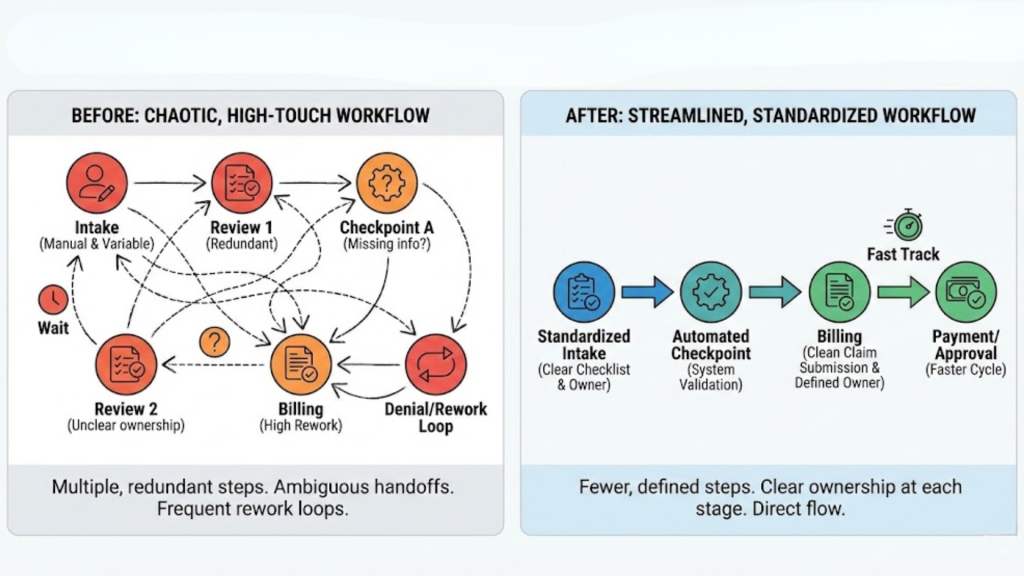
The provider began by mapping the full revenue cycle, from referral intake through claim submission and follow-up.
This exercise highlighted:
- Redundant review steps
- Missing checkpoints
- Informal workarounds that bypassed standards
By visualizing the workflow, leadership could see where errors were being introduced and why billing teams were spending so much time on rework.
Step 2: Standardizing Intake and Documentation
Next, the organization focused on intake—the most common source of downstream issues.
Actions included:
- Creating a single documentation checklist per product category
- Aligning intake requirements with payer expectations
- Eliminating “tribal knowledge” and undocumented shortcuts
This reduced guesswork and improved consistency across locations.
Step 3: Clarifying Ownership and Escalation
Previously, when issues arose, staff often assumed someone else would resolve them.
The provider addressed this by:
- Assigning clear ownership to each workflow stage
- Defining escalation paths for incomplete documentation
- Establishing response-time expectations
Accountability reduced delays and prevented issues from lingering unresolved.
Step 4: Monitoring the Right Metrics
Rather than tracking volume alone, leadership shifted focus to performance indicators tied to quality.
Metrics included:
- First-pass claim acceptance rates
- Denial reasons by category
- Rework frequency
- Billing turnaround time
These metrics provided early warning signs and guided corrective action.
Results: Fewer Denials, Faster Billing, Lower Stress
Within several months, the provider observed measurable improvements:
- Denial rates declined significantly
- Billing turnaround times stabilized
- Rework volume decreased
- Staff reported less frustration and clearer expectations
Importantly, these results were achieved without hiring additional staff.
By fixing workflows first, the organization improved performance and preserved margins.
Why This Approach Worked
The success of this initiative came down to three principles:
- Fix processes before adding capacity
- Standardize upstream to protect downstream performance
- Use data to guide decisions, not assumptions
Workflow optimization created leverage that staffing alone could not.
How Wonder Worth Solutions Helped
Wonder Worth Solutions supported the provider by:
- Analyzing workflow breakdowns
- Identifying root causes of denial risk
- Supporting standardization and accountability initiatives
The focus was on sustainable improvement—not short-term relief.
Conclusion
This case study illustrates a critical lesson for DME providers in 2026: growth challenges are often process problems in disguise. By optimizing workflows instead of expanding headcount, organizations can reduce denials, improve cash flow, and protect compliance—all while controlling costs.