
Answer Summary
Big data forecasting allows DME providers to predict cash flow, identify reimbursement risk, and plan growth using forward-looking indicators instead of lagging reports. In 2026, providers that integrate intake, billing, A/R, denial, and payer-behavior data gain financial visibility that reactive reporting cannot deliver.
Introduction: Why Forecasting Is Now a Leadership Requirement
For years, many DME organizations managed revenue using historical reports: prior-month A/R, trailing denial rates, and year-over-year comparisons. That approach worked when payer behavior was stable.
In 2026, it no longer does.
Payment timing is affected by:
- Prior authorization delays
- Increased pre- and post-payment review
- Payer staffing shortages
- Automated denial logic
- Audit-driven payment holds
As a result, revenue timing matters as much as revenue totals. Leaders need to know not just how much they will earn, but when they will actually get paid.
This is where big data–driven revenue-cycle forecasting becomes essential.
What “Big Data” Really Means for DME Providers
Big data does not mean enterprise-scale systems or data science teams. For DME providers, it means connecting data sources that already exist but are rarely analyzed together.
These typically include:
- Intake and documentation completeness data
- Authorization turnaround time by payer
- Claim submission and acceptance rates
- Denial reasons and frequency
- Appeal outcomes and recovery timelines
- A/R aging and follow-up cadence
- Payment lag by payer and product category
Individually, these reports are familiar. Combined, they become predictive.
Why Traditional Revenue Forecasting Fails in 2026
Most traditional forecasts rely on:
- Historical averages
- Flat growth assumptions
- Static payer behavior
The problem is volatility.
A payer that paid in 18 days last quarter may pay in 32 days this quarter due to internal review changes. A product category with low denial rates may spike after a policy clarification. Static forecasts don’t adjust quickly enough.
Predictive forecasting models:
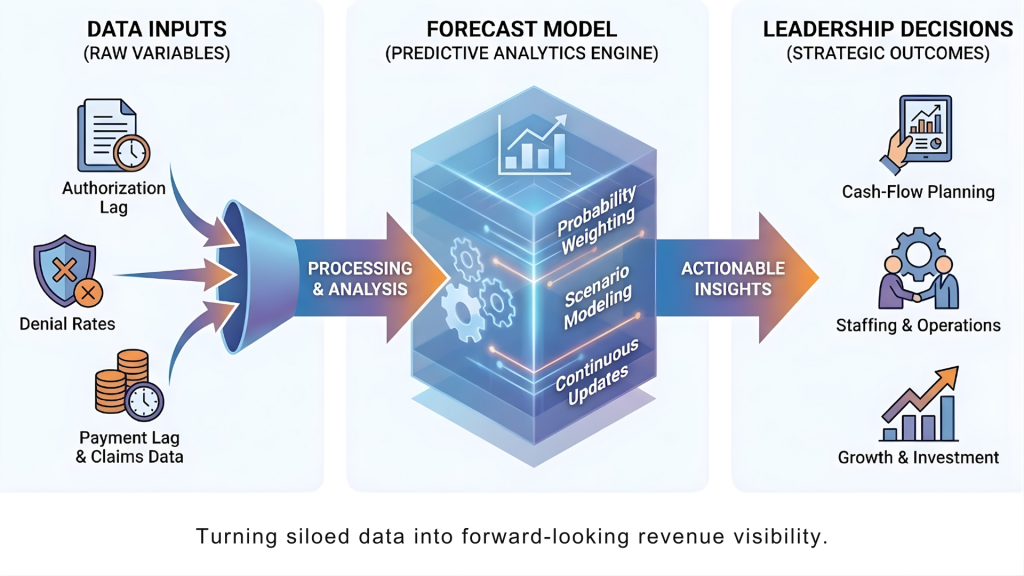
- Update continuously
- Incorporate probability, not certainty
- Reflect operational friction as it happens
This makes them far more useful for real decision-making.
Core Data Inputs That Drive Accurate Forecasting
High-quality revenue forecasting depends on inputs, not algorithms.
The most impactful inputs include:
1. Authorization Lag by Payer
Authorization delays directly affect billing start dates. Tracking average and range (not just average) matters.
2. Denial Probability by Product and Payer
Some product-payer combinations are inherently riskier. Forecasts should weight expected revenue accordingly.
3. Appeal Recovery Rates
Not all denied revenue is lost — but recovery timing varies widely.
4. Billing-to-Payment Lag
Payment speed is often more important than payment likelihood for cash-flow planning.
5. Intake Documentation Error Rates
Upstream errors correlate strongly with downstream delays.
Together, these inputs allow revenue to be modeled realistically.
Practical Forecasting Use Cases for DME Leadership
Predictive revenue-cycle forecasting supports decisions such as:
- Cash-flow planning and credit utilization
- Inventory purchasing schedules
- Staffing and overtime planning
- Evaluating payer contract performance
- Anticipating audit-related payment disruption
- Planning growth without liquidity strain
Instead of reacting to shortages, leaders can plan around them.
Scenario Modeling: From “What Happened” to “What If”
One of the most valuable forecasting capabilities is scenario modeling.
Examples:
- What happens to cash flow if a top payer adds prepayment review?
- What if authorization turnaround increases by 5 days?
- What if denial rates increase by 3% in one category?
Scenario models help leadership test decisions before they become expensive.
Risk Identification Through Pattern Detection
Predictive analytics surface risk earlier by identifying:
- Gradual payer slowdowns
- Documentation drift correlated with delays
- Product categories trending toward audit scrutiny
- Staff capacity constraints impacting billing velocity
Early detection allows correction before revenue disruption escalates.
Compliance and Governance Considerations
Forecasting models must remain transparent.
Under 42 CFR § 424.57, DME suppliers must maintain accurate records supporting billed services. Analytics should:
- Enhance documentation visibility
- Support audit readiness
- Avoid black-box assumptions
Forecasts must be explainable—especially during audits or payer inquiries.
How to Implement Without Overreach
Successful providers:
- Start with one payer or product category
- Validate data quality before modeling
- Compare forecast vs. actual monthly
- Expand gradually
Forecast accuracy improves through iteration, not complexity.
How Wonder Worth Solutions Helps
Wonder Worth Solutions helps DME providers connect revenue-cycle data, identify meaningful forecasting metrics, and translate analytics into operational and financial decisions that protect cash flow and compliance.
Authoritative Resources Referenced
- 42 CFR § 424.57—DMEPOS Supplier Standards
- CMS Medicare Program Integrity Manual
- CMS MLN Matters: Claims & Payment Guidance
- AAHomecare Financial & Operational Resources
Conclusion
In 2026, revenue predictability is a competitive advantage. DME providers that forecast proactively gain control over cash flow, staffing, and growth — while others remain reactive.