Answer Summary
Compliance monitoring only creates value when findings lead to operational action. In 2026, DME providers that translate monitoring data into workflow changes prevent denials, reduce audit exposure, and protect cash flow before disruption occurs.
Introduction: Monitoring Without Action Is Just Reporting
Most DME providers collect compliance data. Far fewer use it effectively.
Reports are generated. Dashboards are reviewed. Findings are noted.
Then operations continue unchanged.
In 2026, that gap between insight and action is where revenue leakage occurs. Monitoring should not exist to “prove oversight.” It should exist to change outcomes.
This article focuses on how DME leaders can convert compliance monitoring results into operational decisions that reduce risk and stabilize revenue.
Why Compliance Monitoring Often Fails to Deliver Results
Monitoring programs usually break down for one of three reasons:
- Too much data, not enough prioritization
- Findings aren’t tied to financial impact
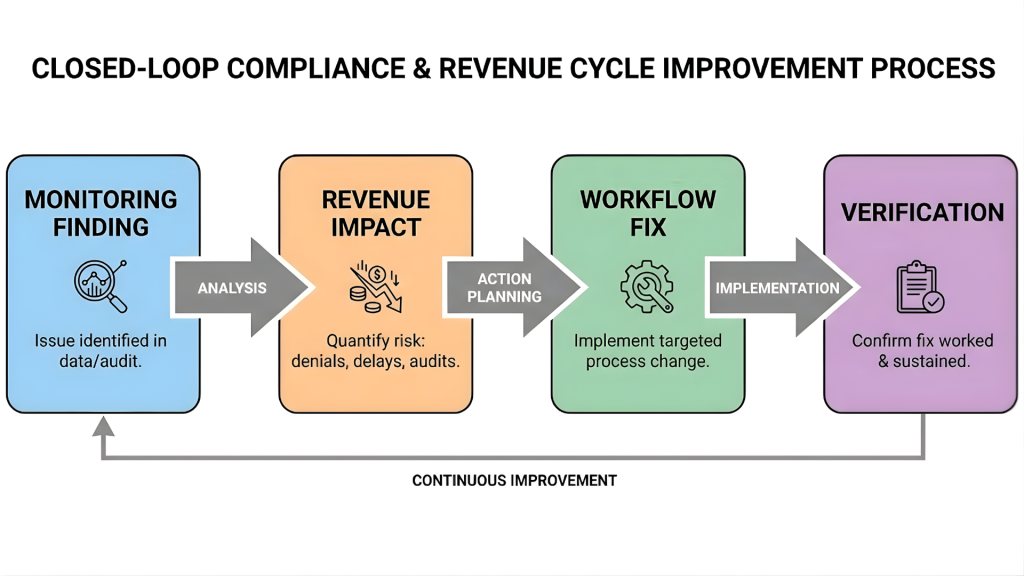
- No clear path from issue → correction → verification
When teams don’t understand why an issue matters, it rarely gets fixed.
Step 1: Classify Findings by Revenue Impact
Not all compliance issues carry the same weight.
Effective programs categorize findings into tiers such as:
- High risk: likely to cause denials, recoupments, or audits
- Moderate risk: causes rework or payment delays
- Low risk: documentation improvement opportunities
Leadership attention should focus on issues that directly affect cash flow timing or recoverability.
Step 2: Link Findings to Specific Workflow Breakpoints
Compliance data becomes actionable when it’s tied to where breakdowns occur.
Examples:
- Missing documentation → intake checklist failure
- Modifier inconsistency → coding standard gap
- Authorization delays → handoff breakdown between intake and billing
When issues are framed as workflow problems—not staff mistakes—solutions become clearer and more sustainable.
Step 3: Assign Clear Operational Ownership
Compliance findings fail when ownership is vague.
Every actionable issue should have:
- A designated owner
- A defined correction plan
- A realistic timeline
Ownership does not mean blame. It means accountability for resolution.
Step 4: Implement Targeted, Not Blanket, Corrections
One of the biggest mistakes providers make is overcorrecting.
Instead of:
- Retraining everyone
- Rewriting every policy
- Adding new approval layers
High-performing teams:
- Target specific teams or steps
- Adjust checklists or templates
- Clarify documentation expectations
- Remove ambiguity
Precision fixes preserve efficiency while reducing risk.
Step 5: Verify That the Fix Worked
Corrections must be validated.
This includes:
- Re-sampling documentation
- Monitoring denial trends post-fix
- Confirming workflow adherence
Without verification, organizations repeat the same fixes year after year without improvement.
How Monitoring Supports Revenue Forecasting
When compliance data is operationalized, it improves forecasting accuracy.
Providers gain insight into:
- Expected denial rates by category
- Likely appeal recovery timing
- Payers creating recurring delays
- Workflow bottlenecks affecting billing velocity
Forecasts become grounded in current operational reality, not historical averages.
Leadership’s Role in Closing the Loop
Leadership determines whether monitoring leads to action by:
- Prioritizing high-impact issues
- Supporting operational changes
- Ensuring findings influence decisions
When leadership treats monitoring as strategic input—not compliance noise—teams follow suit.
How Wonder Worth Solutions Helps
Wonder Worth Solutions helps DME providers transform compliance monitoring from passive reporting into active risk management by aligning findings with workflows, financial impact, and corrective action planning.
Conclusion
In 2026, compliance monitoring is not about proving oversight — it’s about preventing disruption. DME providers that turn findings into action reduce denials, stabilize cash flow, and enter audits with confidence.
Monitoring only matters when it changes what happens next.