Answer Summary
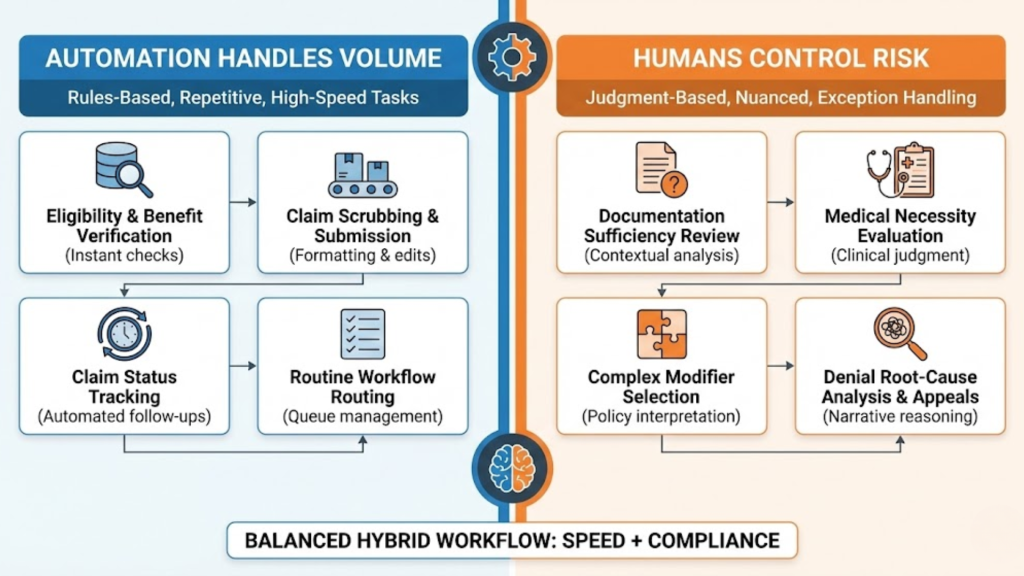
Automation improves speed, consistency, and scalability in revenue-cycle management, but human oversight remains essential for judgment, compliance, and exception handling. In 2026, DME providers achieve the best outcomes by designing hybrid workflows where automation handles volume and humans control risk.
Introduction: Automation Is No Longer Optional—But It’s Not a Cure-All
Automation has become unavoidable in DME revenue-cycle operations. Eligibility checks, claim scrubbing, and status tracking are now expected to move at machine speed. Providers who rely solely on manual processes struggle to keep up with payer demands and volume fluctuations.
However, automation alone does not guarantee improvement. Many providers discover that while automation increases throughput, it can also:
- Accelerate errors
- Mask documentation issues
- Reduce visibility into root causes
- Create audit exposure when exceptions are mishandled
The real challenge in 2026 is not choosing between automation and people—it’s designing workflows where each is used intentionally.
What Automation Does Well in DME RCM
Automation excels when tasks are:
- Rules-based
- Repetitive
- High-volume
- Low-judgment
In DME operations, this includes:
Eligibility and Benefit Verification
Automated eligibility tools reduce delays and minimize manual rework, especially for routine checks across common payers.
Claim Scrubbing and Submission
Rules engines catch formatting errors, missing fields, and known payer edits faster than manual review.
Claim Status Tracking
Automation ensures follow-ups occur on schedule and prevents claims from aging unnoticed.
Routine Follow-Up
Automated work queues help teams maintain consistency and avoid missed deadlines.
Used correctly, automation increases speed and consistency while freeing staff from repetitive tasks.
Where Automation Creates Risk
Automation becomes risky when it is applied to areas that require interpretation or judgment.
Common problem areas include:
- Documentation sufficiency
- Medical necessity evaluation
- Modifier selection in complex cases
- Denial root-cause analysis
Automated systems do not understand context. They execute logic exactly as designed—even when that logic no longer reflects payer behavior or policy nuance.
When automation operates without oversight, errors scale quickly.
Why Human Oversight Still Matters
Human expertise remains essential in areas where:
- Policies are ambiguous
- Documentation varies by case
- Payer rules change frequently
- Appeals require narrative reasoning
Humans excel at:
- Identifying patterns across denials
- Interpreting policy updates
- Adjusting workflows when payer behavior shifts
- Exercising judgment when rules conflict
Removing human review from these areas increases risk rather than efficiency.
Designing a Hybrid RCM Workflow
Effective DME providers in 2026 design hybrid workflows that define clear boundaries between automation and human oversight.
Step 1: Define Automation Boundaries
Identify which tasks automation can complete end-to-end and where review is mandatory.
Example:
- Automation submits claims
- Humans review exceptions flagged by the system
Step 2: Establish Exception Triggers
Automation should escalate cases when:
- Documentation is incomplete
- Denials exceed defined thresholds
- Payer behavior deviates from baseline
Clear triggers prevent silent failures.
Step 3: Preserve Audit Trails
Automated actions must be traceable:
- Who approved exceptions
- What rules were applied
- When overrides occurred
Audit visibility is non-negotiable.
Common Automation Mistakes DME Providers Make
Even well-intentioned automation efforts fail when providers:
- Automate broken workflows
- Skip staff training
- Ignore exception trends
- Assume automation eliminates compliance responsibility
Automation amplifies existing processes — good or bad.
Compliance Considerations in Automated Environments
From a regulatory standpoint, automation does not shift responsibility.
Under 42 CFR § 424.57, DME suppliers remain accountable for:
- Accurate billing
- Proper documentation
- Compliance with payer requirements
Automated systems must support:
- Documentation retention
- Review and override capability
- Transparent reporting
Auditors evaluate outcomes, not tools.
How to Evaluate Whether Automation Is Working
Automation should be judged on outcomes, not activity.
Key indicators include:
- First-pass acceptance rates
- Denial trends post-automation
- Rework frequency
- A/R aging movement
- Staff time redirected to higher-value work
If automation increases speed but worsens accuracy, it’s misaligned.
How Wonder Worth Solutions Helps
Wonder Worth Solutions helps DME providers:
- Evaluate which workflows are ready for automation
- Design hybrid models with clear oversight
- Align automation tools with compliance requirements
- Monitor performance post-implementation
The goal is not maximum automation — it’s controlled efficiency.
Conclusion
In 2026, the most effective DME providers do not choose automation over people. They design workflows where automation handles volume and humans control judgment. When balance is intentional, automation strengthens revenue performance without increasing compliance risk.