Answer Summary
Remote billing teams can improve flexibility and access to skilled talent for DME providers, but only when workflows, documentation standards, and accountability are clearly defined. In 2026, successful remote billing operations depend on structure, visibility, and consistent quality oversight—not physical proximity.
Introduction: Remote Billing Is Here to Stay
Remote billing is no longer an exception in healthcare revenue cycle operations—it’s the norm. Many DME providers adopted remote or hybrid billing models out of necessity, and few intend to return fully onsite.
However, while remote billing expands access to talent, it also introduces new risks:
- Reduced day-to-day visibility
- Inconsistent workflow execution
- Communication gaps
- Compliance drift
The challenge for DME leaders in 2026 is not whether remote billing can work—but how to manage it without sacrificing accuracy, productivity, or audit readiness.
Why Remote Billing Fails Without Structure
Remote teams rarely fail because of skill gaps. They fail because expectations are unclear.
Common problems include:
- Different staff following different processes
- Documentation standards applied inconsistently
- Delays caused by unclear handoffs
- Productivity measured subjectively
When teams are not co-located, informal correction disappears. That makes standardization essential.
What Must Be Standardized First
Before focusing on productivity or technology, providers should standardize the fundamentals.
Key areas include:
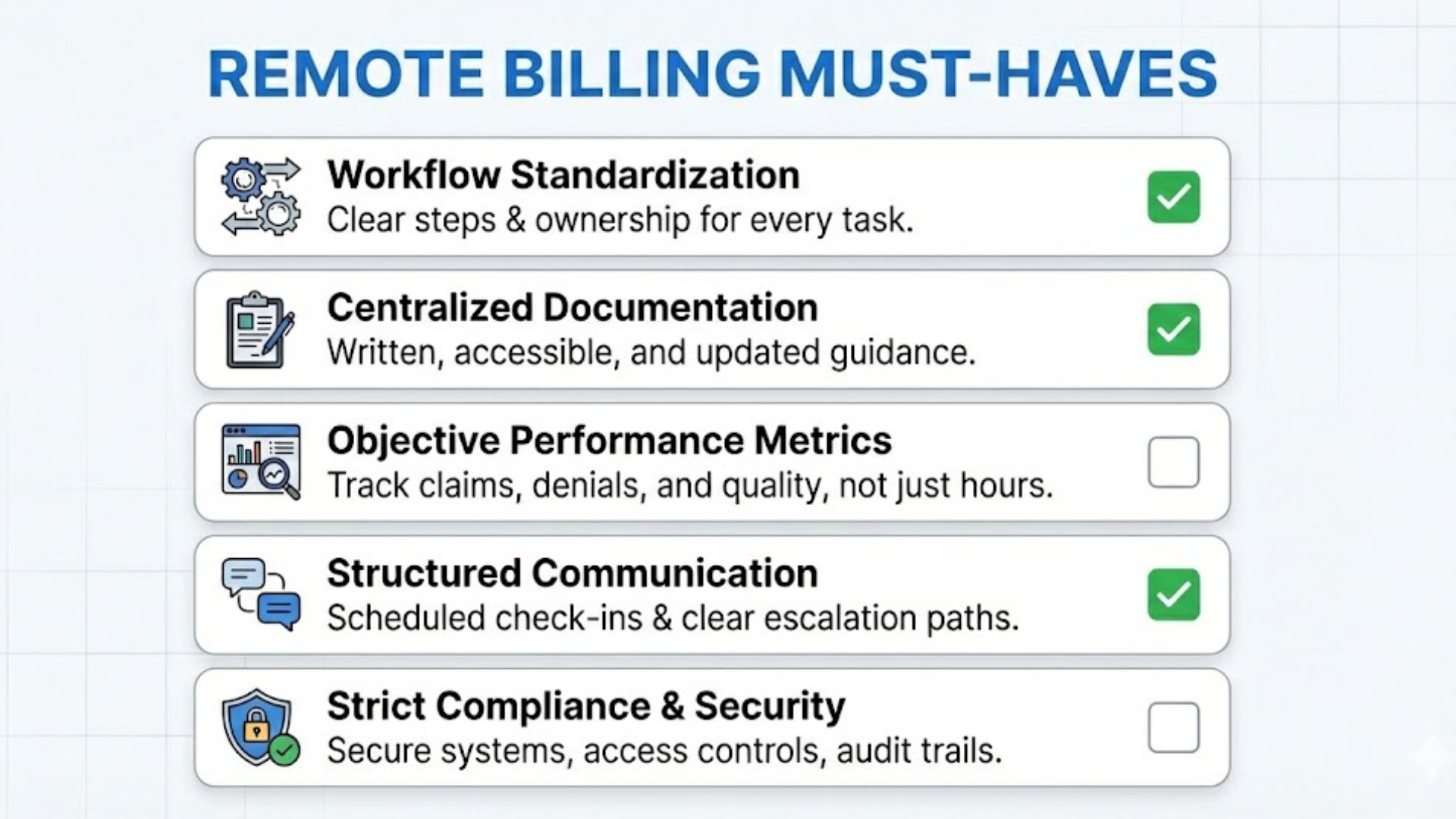
1. Workflow Ownership
Every step—from intake review to claim submission to A/R follow-up—must have a clearly defined owner. Remote teams cannot rely on “someone else will handle it.”
2. Documentation Requirements
Billing staff should never guess what is required to submit a clean claim. Documentation checklists must be:
- Written
- Accessible
- Updated consistently
3. Escalation Paths
Remote staff need to know exactly:
- When to escalate
- Who to escalate to
- What information is required
Without escalation clarity, small issues turn into delays.
Communication Without Constant Interruption
One of the biggest remote-work mistakes is replacing structure with nonstop messaging.
Effective remote billing teams rely on:
- Scheduled check-ins instead of constant pings
- Centralized documentation repositories
- Written guidance for common scenarios
- Clear response-time expectations
This reduces noise while preserving accountability.
Measuring Productivity and Quality Remotely
Remote teams must be managed with objective metrics, not perception.
High-value metrics include:
- Claims processed per day
- First-pass acceptance rates
- Denial trends by biller or team
- Rework frequency
- Aging movement tied to follow-up activity
When performance is visible, distance becomes irrelevant.
Common Remote Billing Pitfalls for DME Providers
Even experienced organizations struggle when they:
- Assume senior staff don’t need structure
- Allow workflows to evolve informally
- Fail to update training materials
- Delay quality reviews
Remote environments amplify weaknesses that already exist.
Compliance Considerations for Remote Teams
From a compliance standpoint, remote billing does not change responsibility.
Under 42 CFR § 424.57, suppliers remain accountable for:
- Documentation accuracy
- Billing integrity
- Audit readiness
Remote access must be paired with:
- Secure systems
- Clear access controls
- Traceable audit trails
Auditors will not accept “remote work challenges” as justification for errors.
How Wonder Worth Solutions Helps
Wonder Worth Solutions helps DME providers design remote billing frameworks that:
- Standardize workflows
- Improve visibility
- Maintain accuracy
- Support audit readiness
The focus is not just enabling remote work—but making it sustainable.
Conclusion
Remote billing teams succeed when expectations are explicit, workflows are standardized, and performance is measurable. In 2026, proximity matters far less than clarity. DME providers that manage remote teams intentionally protect both revenue and compliance—regardless of where staff are located.