Answer Summary
AI-driven inventory forecasting helps DME providers reduce stockouts, lower carrying costs, and stabilize cash flow by predicting demand more accurately. In 2026, the best results come from pairing predictive analytics with disciplined operational controls—so inventory decisions support billing accuracy, compliance, and patient experience.
Introduction: Why Inventory Is a Revenue-Cycle Problem (Not Just a Warehouse Problem)
Inventory is one of the few places a DME provider can “lose money twice.”
- First loss: cash tied up in excess stock, shrinkage, aging product, or unnecessary rentals/purchases.
- Second loss: revenue delayed when stockouts prevent timely delivery, which delays billing and pushes cash collections out.
In 2026, many providers are feeling pressure from:
- rising product and freight costs,
- reimbursement volatility,
- payer utilization management,
- longer authorization cycles,
- staff capacity constraints.
That combination makes inventory guesswork expensive. Predictive analytics can help—but only when implemented with real-world guardrails that keep decisions compliant and financially responsible.
What “AI Inventory Management” Means in Real DME Operations
AI inventory management is not a single feature; it’s a set of forecasting and decision-support capabilities. In practical terms, predictive inventory systems attempt to answer:
- What will we need?
- When will we need it?
- How confident are we in that forecast?
- What happens if authorizations or payer timelines shift?
- Where are we overstocked, and why?
A well-designed approach uses historical and operational signals like:
- product utilization by category (e.g., CPAP supplies, mobility, wound care),
- seasonal patterns,
- referral and discharge trends,
- payer authorization turnaround time,
- order-to-delivery cycle times,
- returns and exchanges,
- backorder frequency and supplier lead times.
The goal isn’t “perfect predictions.” The goal is better decisions, earlier.
The 5 Most Common Inventory Failure Points (and How AI Addresses Them)
1) Static reorder points that don’t match reality
Many DME providers still rely on fixed min/max thresholds. That breaks when demand changes due to seasonality, payer behavior, or referral patterns.
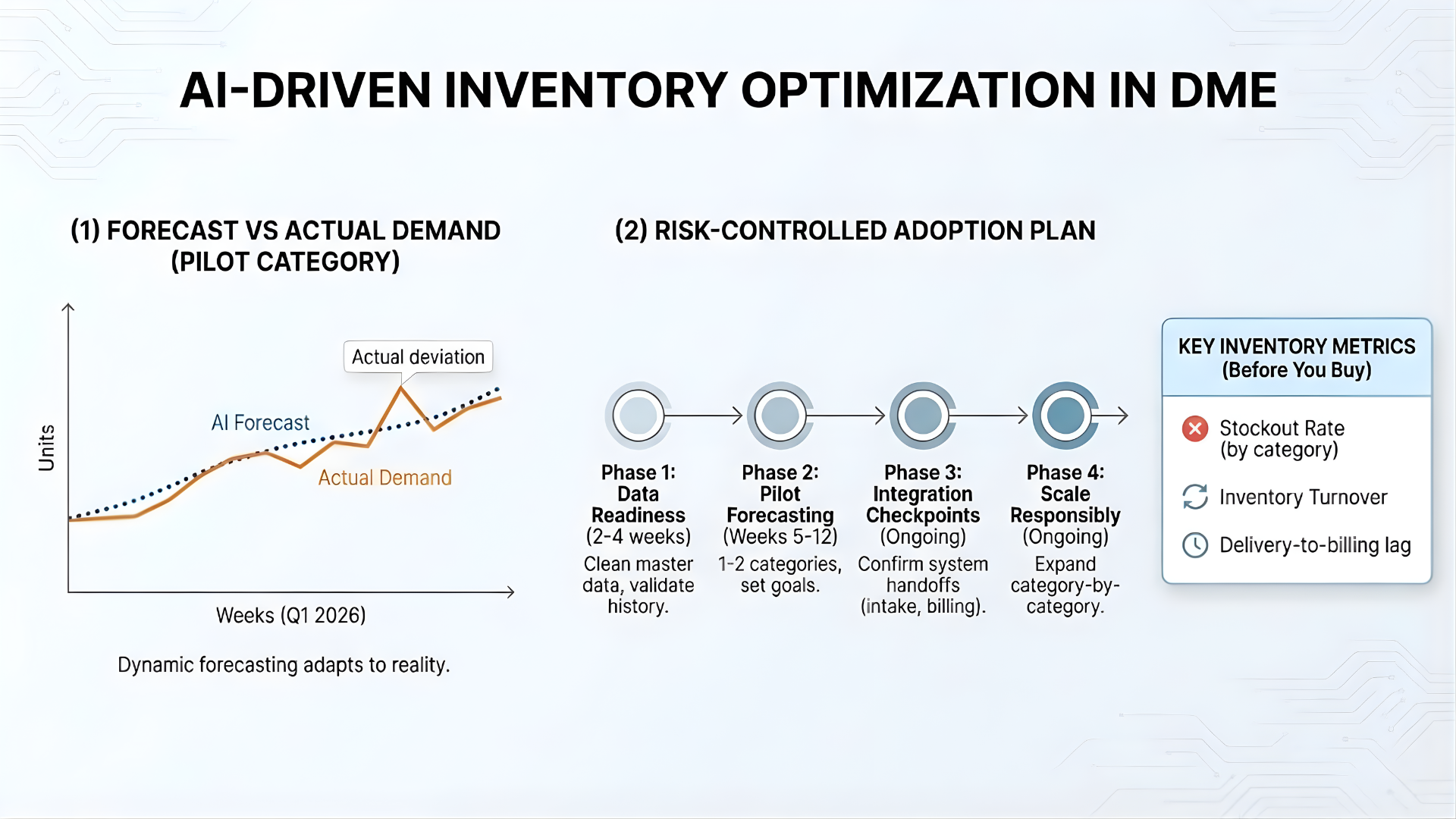
What AI helps with: dynamic forecasting that adapts to trend changes.
2) Disconnected billing and inventory workflows
When inventory is managed separately from billing readiness, teams can deliver the item—but billing can stall due to documentation gaps, authorization issues, or mismatched records.
What AI helps with: forecasting that incorporates workflow timelines (authorization + documentation + delivery readiness).
3) “Emergency purchasing” from poor visibility
Rush orders raise costs and can introduce product variance.
What AI helps with: early alerts when forecasted demand is trending beyond current stock.
4) Overstock driven by fear (not data)
Overstock may feel safe, but it degrades cash flow and increases holding costs.
What AI helps with: showing demand probability and confidence bands so you can stock intelligently, not emotionally.
5) Lack of accountability for forecast performance
Many teams don’t measure accuracy or revise processes.
What AI helps with: continuous performance tracking and refinement.
The Data Layer: What to Measure Before You Buy Anything
To avoid “dumb AI,” start with the metrics you want to improve. At minimum, track:
- Stockout rate (by product category)
- Fill rate / on-time fulfillment
- Inventory turnover
- Days of inventory on hand
- Carrying cost (storage + capital + shrink)
- Backorder frequency and average delay
- Return/exchange rate
- Order-to-delivery cycle time
- Delivery-to-billing lag (how long after delivery billing is actually clean and ready)
These metrics determine whether you need:
- forecasting improvements,
- workflow integration improvements,
- or both.
Forecasting Models: What Works Best for DME
Different DME categories behave differently. That matters.
- Consumables (supplies): typically more predictable; strong candidate for forecasting models based on consumption patterns and reorder cycles.
- Capital items (mobility, specialty equipment): more variable; forecasting may rely more on referral trends, discharge data, or historical ordering seasonality.
- Rental-heavy categories: forecasting must incorporate rental duration and return probability.
A practical model strategy for many providers:
- start with high-volume SKUs (largest impact),
- create a forecast for A-items (highest value/volume),
- then expand to B/C items once the workflow is stable.
Cash Flow: How Better Forecasting Turns Into Faster Reimbursement
Inventory improvement isn’t just cost control. It affects reimbursement through timeliness:
- Better stock levels → faster delivery
- Faster delivery → faster billing trigger
- Faster billing → earlier payment cycle start
Conversely:
- stockouts push delivery out,
- delivery pushes billing out,
- billing pushes collections out,
- collections pushes staffing and purchasing decisions into stress mode.
Inventory is one of the earliest levers in the chain.
Compliance + Audit Considerations (Where Inventory Mistakes Create Risk)
Inventory intersects compliance through:
- proof of delivery,
- correct item selection and documentation alignment,
- audit-ready record retention,
- accurate billing records tied to actual dispensed items.
Under 42 CFR § 424.57 (Supplier Standards), suppliers must maintain accurate, accessible records supporting billed items and services. Predictive analytics can help, but it must not create “black box decisions” that reduce traceability.
Practical compliance safeguards
- Ensure item dispensed matches documentation and authorization requirements.
- Maintain clear audit trails for: order → pick/pack → delivery → billing.
- Enforce standardized documentation requirements at intake and pre-delivery.
Predictive tools should increase visibility—not obscure decision-making.
Implementation Reality: A Risk-Controlled Adoption Plan
Phase 1: Data readiness (2–4 weeks in most orgs)
- Confirm clean item master data (SKUs, descriptions, UOM)
- Standardize naming conventions
- Validate historical sales/usage records
- Identify “dirty data” sources (manual spreadsheet overrides, duplicates)
Phase 2: Pilot forecasting on 1–2 categories
Pick a category with:
- meaningful volume,
- stable ordering patterns,
- manageable number of SKUs.
Set measurable goals:
- reduce stockouts by X%,
- reduce emergency purchases by Y%,
- improve turnover by Z%.
Phase 3: Integration checkpoints
Confirm system handoffs:
- intake documentation completeness,
- authorization tracking,
- delivery confirmation,
- billing readiness.
Phase 4: Scale responsibly
Expand category-by-category—don’t flip the whole warehouse at once.
Executive Decision Framework: “Should We Do This Now?”
Ask:
- Are stockouts causing delivery delays and billing lag?
- Is cash tied up in slow-moving inventory?
- Do we have enough clean historical data to forecast?
- Do we have operational discipline to measure and improve performance?
- Can we integrate inventory decisions with billing readiness?
If the answer is yes to at least 3–4 of the above, predictive analytics is likely a strong investment.
How Wonder Worth Solutions Helps
Wonder Worth Solutions helps DME providers connect analytics with operations—so predictive inventory decisions translate into better fulfillment, cleaner billing readiness, and more stable cash flow. We focus on workflow alignment and compliance safeguards so technology improves outcomes without increasing risk.
Authoritative Resources Referenced
- 42 CFR § 424.57 — DMEPOS Supplier Standards
- CMS Medicare Claims Processing Manual
- CMS MLN Matters: Proof of Delivery & Documentation Guidance
- AAHomecare operational and compliance resources
Conclusion
In 2026, inventory optimization is no longer optional—it’s a financial and operational necessity. Predictive analytics can dramatically reduce stockouts and carrying costs, but the real win comes from disciplined implementation: clean data, measurable goals, and workflow integration that protects compliance while improving speed.